
In Memoriam: Professor Kenneth Wells
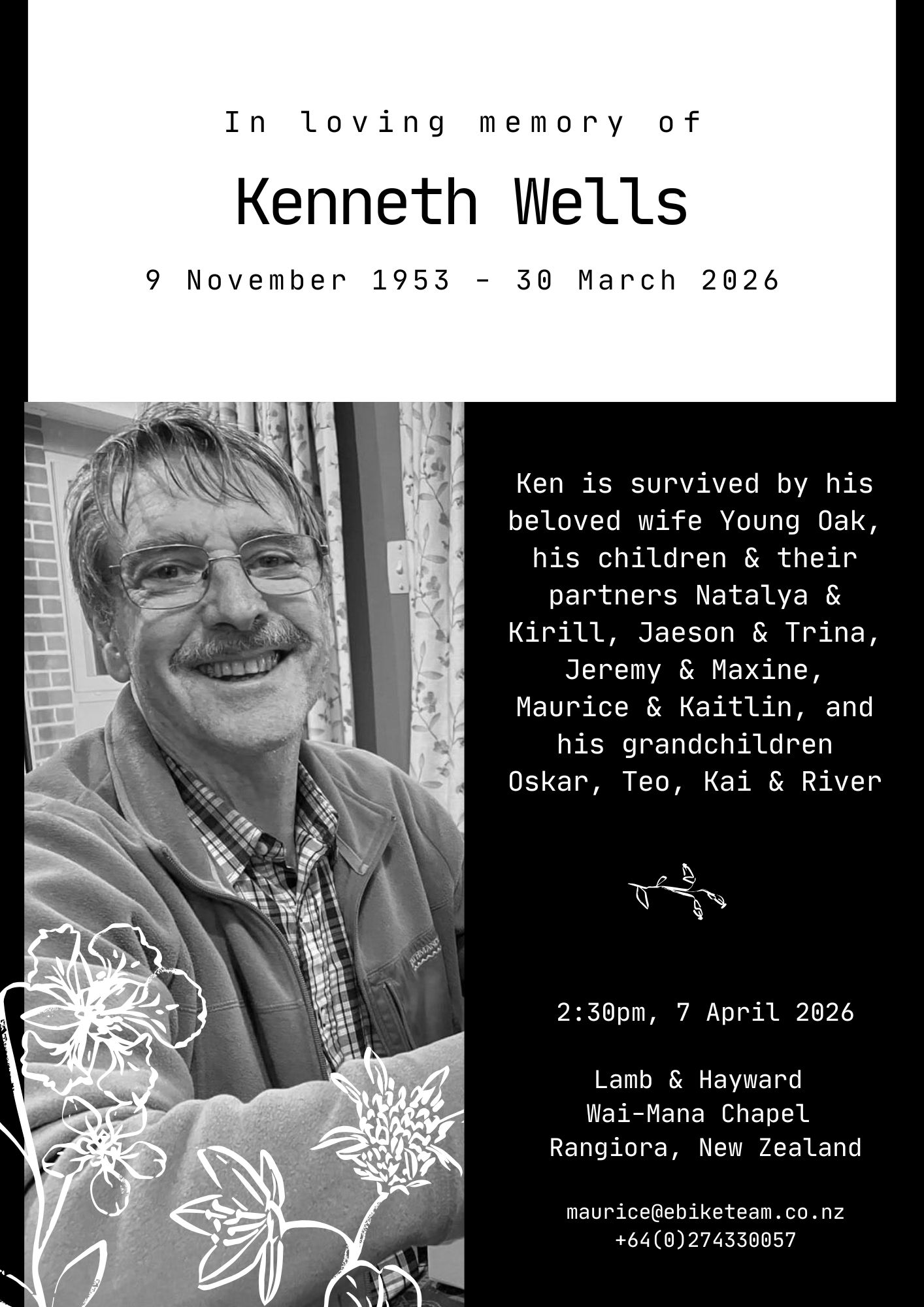
Professor Kenneth Wells participated in the AKSE conference in Prague in 1995 and was a friend to many in the European Korean Studies community. We were saddened to learn of his passing on 30 March in New Zealand, and share the following obituary written by Dr. Gregory N. Evon (UNSW Sydney).
Dear Members of the Korean Studies Community,
I write to inform you that one of the leading figures in Korean Studies, Professor Kenneth Wells, passed away on 30 March in New Zealand.
I first met Ken in September 1986, when I began studying at Indiana University, Bloomington. I had little desire “to go to college,” as they say in the US, and was set on joining the Air Force, like some of my older friends. In the end, parental pressure (“you must go to college!”) won out over peer influence. In July 1986, my father took me to the induction process at Indiana University, which included looking at possible courses. I vividly remember walking through Franklin Hall until I came to the board for East Asian Studies. One of the options was a level one Korean language class, and I figured “why not?” It seemed at least reasonably appropriate since (1) I had no idea what to study and (2) by then had spent most of my high school years doing Hapkido. Little did I know what a pivotal decision that was.
My very first college course was on a Monday at 9:00 a.m. at Ballantine Hall. It was also Ken’s first in the US. There were roughly twenty students, and we were all chatting when this white guy with a beard walked in and introduced himself. We understood that he was our Korean language teacher, but otherwise we were mystified at the most elemental thing: his name. Finally, Ken wrote “Wells” on the blackboard, thus making clear to us that his name was not “Wurz.” That was our introduction to the peculiarities of vowels in New Zealand English, and so we got a bit of New Zealand English tossed in with Korean.
The students adapted well, but pronunciation is one thing and expressions another. Disaster struck in the lead-up to the Thanksgiving break, after which we were to take a major exam. Ken ended the class by asking if we had any “burning questions.” There were two problems here. First, none of us had ever heard the expression before. Second, there was the vowel problem. The entire class went silent, and Ken knew something was wrong but had no idea exactly what was going on. Finally, an older student raised his hand and asked, “Professor, I don’t want to be rude, but why are you talking about burning Christians?” Over those previous weeks, Ken was serious, but at that moment, we got to see that he had a quirky sense of humour and that when he laughed, he laughed hard. And so to the blackboard he went, spelling out “questions,” as he and all of us students howled with laughter.
The mix of students was atypical compared to the average college classroom. There were the eighteen-year-old freshmen like me, but also older students—usually, but not always male—who had been in the military and stationed in South Korea. This led to a curious imbalance when Ken, in something of a tradition during his time at Indiana University, invited the students to his home for a party featuring Korean food prepared by wife, Young-Oak. The more worldly among us knew what was what and were delighted. The rest, like me, were a bit more cautious. I remember my initial scepticism over kimchi (it did not last long) and wonderment that a people who had created that had also created a delectable dish called chapch’ae.
A few years later, Ken and his family moved to the outskirts of town, to a home with a paddock. The annual parties shifted there. And there, too, Ken brought a bit of New Zealand to southern Indiana by acquiring sheep, including a big ram that his kids appropriately named “Lambo.” This venture had its own hilarities. At one point, Ken and a professor friend drove to Kentucky to pick up a lamb to add to the flock, bringing it back in the backseat of a beat-up Datsun. Funny enough, but they also stopped at a bar to get a bite to eat and a beer on the trip and shocked the Kentucky locals by asking if they had Fosters. I remember hearing this story and thinking “are you crazy?” Since my father was a prosecutor, I had it drummed into my head since I was a little kid that one of the most dangerous things you can do is to go into a bar that you don’t know in a place that you don’t know.
In that sense, Ken could be quite innocent, although one was not always sure where the innocence ended and the quirky sense of humour began. The sheep farm provided a prime example of this conundrum in the form of an annoying neighbour (a lawyer, no less, as I recall) and his unruly German Shepherd that kept harassing Ken’s sheep. A normal American (and as anyone who knew Ken knows all too well, he was not American, normal or otherwise) would have shot the dog. Not Ken. Instead, he kidnapped the dog after catching it lurking about the paddock (apparently, the hound was quite nice when not harassing the sheep) and took care of it for a considerable period (carefully informing the owner of the ever-rising food bill). Eventually, a truce was reached, and a Hatfield-McCoy feud was avoided.
Several years after receiving tenure at Indiana, Ken took a job at The Australian National University in 1994. By that point, his pathbreaking work, New God, New Nation: Protestants and Self-Reconstruction Nationalism in Korea, 1896-1937 (University of Hawaii Press, 1991), had been published and his edited volume, South Korea’s Minjung Movement: The Culture and Politics of Dissidence (University of Hawaii Press, 1995), was in press. Ken quickly established himself as a leader and advocate for Korean Studies in Australasia as the founding president of the Korean Studies Association of Australasia in 1994 as well as the head of the ANU’s Centre for Korean Studies. I was fortunate to receive a scholarship from the ANU and went there in 1995 to continue my PhD under Ken’s supervision. I saw much of that effort on his part up close, and in 2003, Ken received much-deserved recognition when he was appointed the endowed Korea Foundation Professor of Korean History at the ANU.
In 2009, Ken embarked on a new adventure when he took a position teaching Korean history at Berkeley for three years. Although most who knew Ken think of his passion for mountaineering (not hiking, but serious mountain climbing), he also was a bit of a car enthusiast, and I recall a photo of him next to a bright yellow Ford Mustang that he rented for a trip down the California Pacific Coast Highway.
After Ken’s California adventure, he retired to New Zealand with his wife and set up a hazelnut farm. But he also remained an active scholar and travelled worldwide to give talks and did not exactly retire in any conventional sense. He was a Research Fellow at the New Zealand Asia Institute and an Adjunct Professor of history at the University of Canterbury in Christchurch, New Zealand, where he also occasionally taught. Over this time, he worked on his fine study, Korea: Outline of a Civilisation (Brill, 2015), as well as another project that he and his wife worked on for nearly two decades: a biography of her uncle, who ended up in the Soviet Union after the Korean War, entitled Too Fast, Too Slow (Seoul: SeodoAD [서도출판사], Feb. 2026).
It is gratifying to know that Ken received copies of the biography in the final weeks of his life. In one of our last conversations, he told me that he was reading the book by a fire. “Any typos?” “Nope, they did a good job,” he replied with a chuckle.
For those who are interested, the family asks that in lieu of flowers, a charitable donation in Ken’s name be made to Hinewai Nature Reserve; donation details are on their homepage (https://www.hinewai.org.nz/ ).
Those who would like to send condolences to the family may do so at Young-Oak Wells 380 Ashley Gorge Road, RD1 Oxford 7495, New Zealand.
Sincerely,
Dr. Gregory N. Evon
History and Area Studies
School of Humanities & Languages
ARTS, DESIGN, and ARCHITECTURE
UNSW SYDNEY, NSW 2052
AUSTRALIA
email: g.evon@unsw.edu.au